

Overview
Mayan Stonecrafters, Inc.’s clients often want their countertops to make a stronger statement. Something more refined and visually substantial. In this case, we often recommend a mitered edge, but what exactly does that mean, and why might it be the right choice for your space?
This blog answers those questions and more. You'll learn what materials work best, where these edges shine, and who benefits most from their striking look.
Highlights
- What is a mitered edge?
- Comparing edges
- Why edge thickness matters
- The best materials for a mitered edge
- Customizing your edge
- Is this edge right for you?
Introduction
A countertop doesn’t need bold colors or exotic materials to command attention. Sometimes, the real impact comes from the edge because of how it frames the surface and anchors the entire room.
However, there are lots of other edge profiles to choose from, not to mention how they can be customized. Learning about how mitered options are built and when they’re most effective helps you rule out less cohesive choices and ultimately make more confident design choices.
What Is a Mitered Edge Countertop?
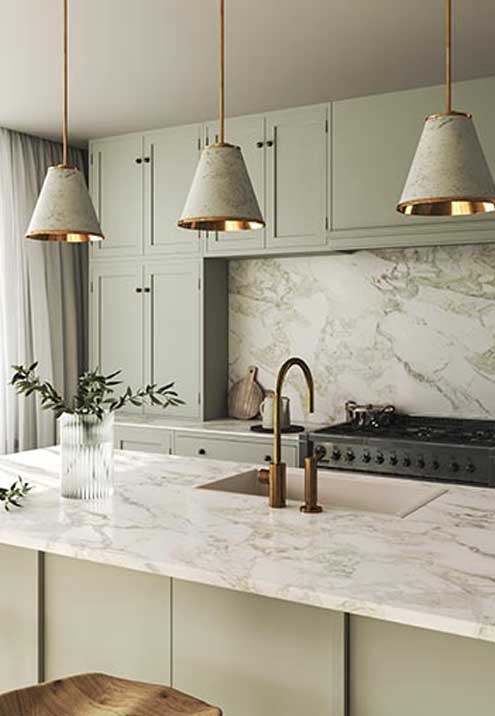
A mitered edge countertop is built by joining two pieces of stone at a precise 45-degree angle to form a seamless corner. This technique creates the illusion of a much thicker slab without adding excessive weight or cost. It also allows fabricators to extend the face of the material downward.
Visually, the result is clean and continuous. The veining or pattern of the stone appears to flow naturally from the surface down the edge, uninterrupted by bulky seams or stacked layers. It draws the eye without feeling forced, lending a tailored look to any space.
How Does a Mitered Edge Compare to Other Edges?
You may already be learning toward a mitered edge, but comparing it with other edge profiles will clear up any last-minute doubts. An eased edge is one option. It offers a simple, squared-off finish that suits a range of interiors. Unlike a mitered edge, it exposes the slab’s actual thickness, giving a lighter, more understated profile. People who choose it generally prioritize function and subtlety.
Bullnose edges are also common, especially in traditional homes. With their fully rounded shape, they soften the lines of a countertop and reduce sharp corners. In contrast, a mitered edge maintains sharp geometry, which creates a more modern and intentional feel.
Then there’s the beveled edge, which features an angled cut along the top edge of the slab. It adds a decorative line without increasing visual weight. Compared to a mitered edge, it draws less attention and works best when you want detail without depth.
Laminated Edge vs Mitered Edge
Very often, the choice comes down to a laminated edge or a mitered edge, which is why this comparison deserves a closer look. Both are used to create the appearance of a thicker countertop, but they achieve it in very different ways and with noticeably different results.
A laminated edge bonds a second strip of stone beneath the slab to double its thickness from the bottom. A mitered edge, on the other hand, wraps the vertical face seamlessly from the top. People tend to choose laminated edges for cost and simplicity, while mitered edges appeal to those who want a more refined, uninterrupted look.
Why Does Countertop Edge Thickness Matter?
A mitered edge creates the illusion of greater thickness, giving the countertop a stronger visual presence. But why does thickness matter in the first place, and how can it influence both design impact and spatial perception?
Think about how thickness changes your perception of quality. For many, a more substantial edge suggests durability and craftsmanship, even if the underlying materials are the same. Though this is merely personal preference, it’s often more common to see thin edges as cheaper than the reverse.
Edge thickness also affects proportion. A countertop with added depth can complement oversized cabinetry or elevate the look of a floating vanity. In spaces where scale plays a role, like large kitchens or open bathrooms, a thin edge can feel lost or unfinished.
What’s the Right Mitered Edge Thickness?
There are different mitered edge thicknesses to choose from, each creating a slightly different effect. Of course, there’s no single best choice, or even just a few common picks, that work for everyone. The right thickness depends on the proportions of your space, the statement you want to make, and how the countertop interacts with nearby features.
Here are a few options you can discuss before the countertop fabrication process:
- 1½ inches: Chosen for a clean, understated look in smaller kitchens or bathrooms
- 2 inches: Offers subtle visual weight without overwhelming nearby features
- 2½ inches: Popular for creating a balanced, custom feel in open-concept spaces
- 3 inches or more: Used to make a bold, architectural statement or complement oversized cabinetry
Is a Two-Inch Mitered Edge Countertop Standard?
You might’ve heard that a two-inch mitered edge is the standard for upscale countertops. That’s not necessarily wrong, but it’s more of a starting point than a rule. While two inches is the best look for many, the right thickness still depends on other factors.
Two inches tends to strike the right balance, though. It’s thick enough to feel intentional and substantial without making the counter appear bulky. For most kitchens and bathrooms, this middle ground pairs well with standard cabinet dimensions and doesn't overpower nearby elements. However, the right thickness depends on your space.
Go too thin, and the edge can lose its impact, especially in larger rooms. Pushing too far in the other direction may cause the countertop to dominate the space or feel disproportionate to surrounding features. The goal is a look that enhances, not overwhelms.
What Countertop Materials Work With a Mitered Edge?
Mitered edges can be applied to any solid countertop material, including quartz, granite, and marble. The technique relies on clean cuts and precise joints, so it’s more about fabrication skill than material limitations. As long as the slab is strong and consistent enough to handle a miter cut, the choice is yours.
In quartz, mitered edges are especially effective. The uniform patterning and lack of natural variation allow the seam to nearly disappear, making the edge look like a single piece. This material lends itself well to modern designs that emphasize clean lines and consistent surfaces.
Granite works well, too, though it has more natural veining and grain to consider. Matching patterns across a miter joint can be more complex, but when done well, it creates a striking visual flow. It’s a good choice for those who want a dramatic edge with organic character.
Marble is perhaps the most delicate but also the most rewarding stone. Its softness requires extra care during fabrication, but the natural veining can wrap beautifully across a mitered edge. It’s often used in spaces where the countertop is meant to be the visual centerpiece.
Can You Customize the Look of Mitered Edges?
Mitered edges can be customized in both subtle and dramatic ways. Since they’re crafted from separate pieces joined with precision, there’s flexibility in how the edge is shaped, how far it extends, and how it complements the countertop’s overall design.
One example is adjusting the angle of the drop edge. Instead of a straight vertical return, the mitered portion can slope or taper inward, softening the profile and creating a more sculptural look.
Here are a few other customization options:
- Varying the depth of the overhang for visual balance
- Adding an apron front to match cabinetry or furniture styles
- Integrating built-in lighting beneath the edge
- Choosing a contrasting mitered return in a different material
- Extending the edge down to the floor for a full waterfall effect
Are Mitered Edge Countertops Right for You?
By now, you have a clearer picture of what sets mitered edge countertops apart. However, when it comes to making a final decision, there’s still a layer of personal context that hasn’t been covered. Those details, like budget and space planning, are best explored during a design consultation. Still, a few broader considerations can help guide your thinking.
One is the level of contrast you want between your countertop and cabinetry. Mitered edges naturally draw attention, so if your base cabinets are simple or flat-faced, the edge can introduce depth and detail without adding ornamentation. If the cabinetry is already highly decorative, though, a subtler edge might suit the balance better.
Lighting is another. Mitered edges create deeper shadows and more defined lines, which can add richness in well-lit spaces or appear too stark under cool or uneven lighting. If your room relies on natural light or uses warmer fixtures, the edge will likely read as clean rather than harsh or heavy.
Talk to a Top Countertop Fabricator About Edge Profiles Today
Mayan Stonecrafters, Inc. brings a level of care to fabrication that few can match. As an expert countertop fabricator, we focus on the finer details, and the edges are no exception. Whether you’re exploring the mitered edge or another finish entirely, we can help you understand what works best for your layout and design goals.
Call (321) 821-4381 to get started with a personalized countertop consultation.